
Reviewed by Maged Sharaf, Ph.D., Senior Director for Labeling, Cannabis and Claims Consulting Services, EAS Consulting Group
1-Minute Summary
- Undeclared allergens are a leading cause of dietary supplement recalls, making proactive control essential.
- U.S. regulations (DSHEA, 21 CFR Part 111, and FALCPA) set expectations for allergen labeling.
- Allergens can enter your product through raw materials, processing aids, or cross-contamination, even without being an intentional ingredient.
- A five-step allergen control plan, including testing, supplier verification, and documentation, protects both consumers and your brand.
Why Dietary Supplement Allergen Control Is Under Scrutiny
In April 2025, a popular supplement was pulled from store shelves and online retailers after the FDA announced a nationwide recall. The reason? Undeclared wheat. The affected product was widely distributed through Amazon and other e-commerce platforms. For a consumer with a wheat allergy or gluten intolerance, that oversight could have triggered a serious reaction.
Allergen-related recalls like this are becoming a major driver of dietary supplement allergen control efforts. In fact, undeclared allergens are the top reason for food recalls, and it’s becoming an increasingly common reason for supplement recalls, too.
If you’re in Quality Assurance or Quality Control, it’s not enough to follow cGMPs and trust your supply chain. You need a proactive supplement allergen control strategy. Here’s what you need to know.
What Is a Dietary Supplement Allergen?
An allergen is a protein or protein derivative that triggers an immune system response in sensitive individuals. This is different from food intolerance, which does not involve the immune system (e.g., lactose intolerance).
Reactions to allergens can range from mild itching or hives to life-threatening anaphylaxis; they often happen within minutes of exposure.
Common dietary supplement allergens include:
- Milk (whey, casein proteins)
- Soy (common in excipients and as a source of lecithin)
- Wheat/wheat proteins (e.g., gluten), including binders and protein blends
- Egg (e.g., albumin)
- Tree nuts/peanuts
- Fish/shellfish (e.g., marine collagen)
- Sesame (required to be labeled as of 2023 under U.S. law)
These ingredients can appear in unexpected ways, particularly in botanical blends, flavorings, and extracts.

Regulations that Drive Supplement Allergen Control
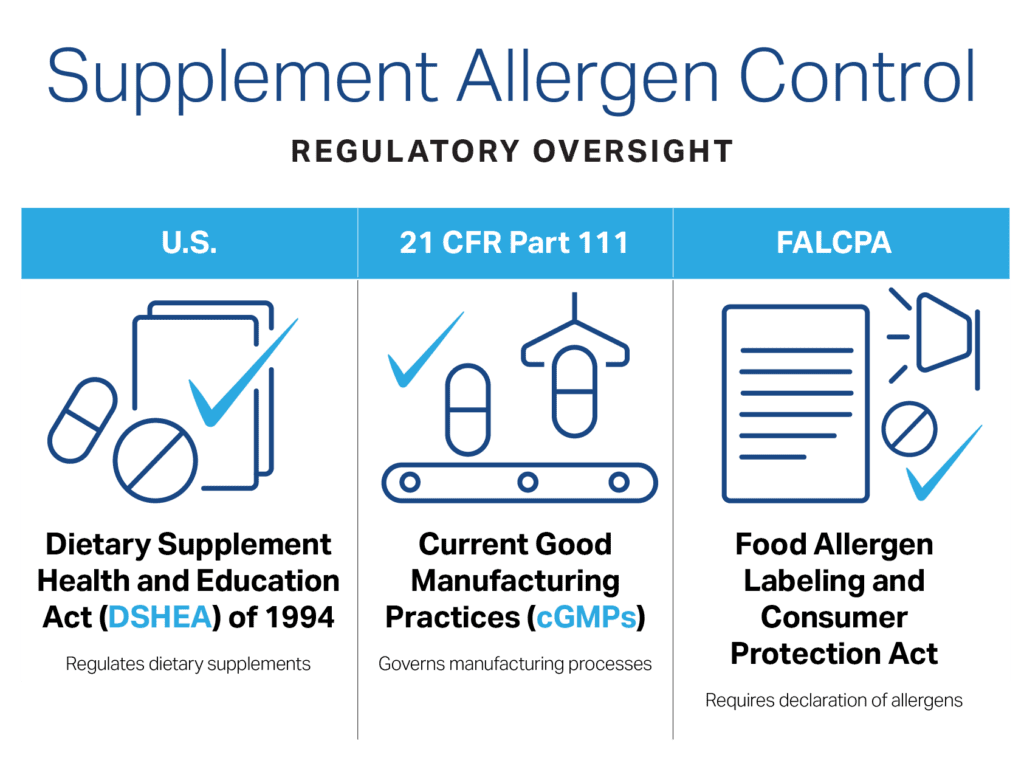
In the U.S., dietary supplements are regulated under the Dietary Supplement Health and Education Act (DSHEA) of 1994, along with 21 CFR Part 111, which governs current Good Manufacturing Practices (cGMPs).
Supplements are also subject to the Food Allergen Labeling and Consumer Protection Act (FALCPA) when they contain any of the Big 9 allergens: milk, egg, fish, crustacean shellfish, tree nuts, peanuts, wheat, soybeans, or sesame.
| If present, allergens must be clearly listed in either the ingredient list or in a “Contains” statement.
However, FALCPA does not require allergen testing, only accurate labeling. That’s a critical distinction. If a food product contains an allergen that is not listed on the label, it’s considered misbranded since the label is false or misleading. A product is adulterated if an allergen is present due to cross-contact or lack of GMPs control.
Food products have stricter enforcement pathways under FSMA (Food Safety Modernization Act). Regulators expect allergen risk to be addressed through supply chain controls and GMPs.
Allergens Can Enter Your Products Unintentionally
Correct testing and labeling are obvious when your products contain any of the FDA Big 9 allergens. But allergens can enter your supply chain unintentionally through the supply chain or cross-contamination.
For example, botanicals, proteins, excipients, and flavorings come from around the world. Changes in processing or sourcing can introduce allergens, even when not declared.
In addition, label claims like “gluten-free” or “nut-free” help products appeal to consumers today, but they must be backed with testing. Regulators and consumers expect claims to be truthful and not misleading.
Even if your supplements don’t use known allergens, testing is still important to verify the integrity of your raw materials, confirm supplier COAs, and back up label claims.
5 Steps to Improve Dietary Supplement Allergen Control
Effective supplement allergen management requires a holistic approach that encompasses your entire supply chain and product process. Here’s a practical roadmap:
1. Risk Assessment
- Test raw materials for allergens, including fillers and excipients.
- Confirm allergen status with all suppliers.
- Watch for changes in ingredient sourcing or processing.
2. Supplement Allergen Control Testing Methods
- ELISA: Ideal for detecting proteins from allergens like milk, egg, or peanut.
- PCR: Useful for detecting DNA from allergenic sources.
- Mass spectrometry: Best for complex matrices or highly processed products.
- Lateral flow devices: Great for on-site screening.
We explain ELISA and PCR allergen testing in depth here, including which method is right for your samples.
3. Environmental Monitoring
- Swab equipment and surfaces for allergen residues to detect potential cross-contamination.
- Pay close attention to shared mixers, tablet presses, and encapsulation equipment.
4. Supplier Verification
- Require and verify supplier Certificates of Analysis (COAs), as required per 21 CFR 111 for component identity testing, at minimum.
- Conduct periodic supplier audits.
- Confirm change-control protocols are followed.
5. Labeling and Documentation
- List allergens in the list of ingredients, either by their common names, in parentheses (e.g., “whey (milk)”), or in a separate “Contains” statement right after the ingredients (e.g., “Contains: Milk, Wheat, Soy”). Precautionary warnings may also be used like “May contain nuts” or “Processed in a facility with” near the ingredient list for potential cross-contamination.
- Keep records that validate your control decisions.
Get Help With Your Dietary Supplement Allergen Control Program
The rise in allergen-related recalls is a wake-up call for the supplement industry. Even if you’re not required to test, you’re still responsible for keeping undeclared allergens out of your products.
Dietary supplement allergens are a high-risk quality issue. A proactive allergen control strategy that includes testing, environmental monitoring, and supplier oversight helps protect your customers and your brand.
If you need help with your allergen program, including allergen lab testing, our team is here to help.