
Reviewed By Steven Rogers, Corporate Quality Manager, Certified Group
1-Minute Summary
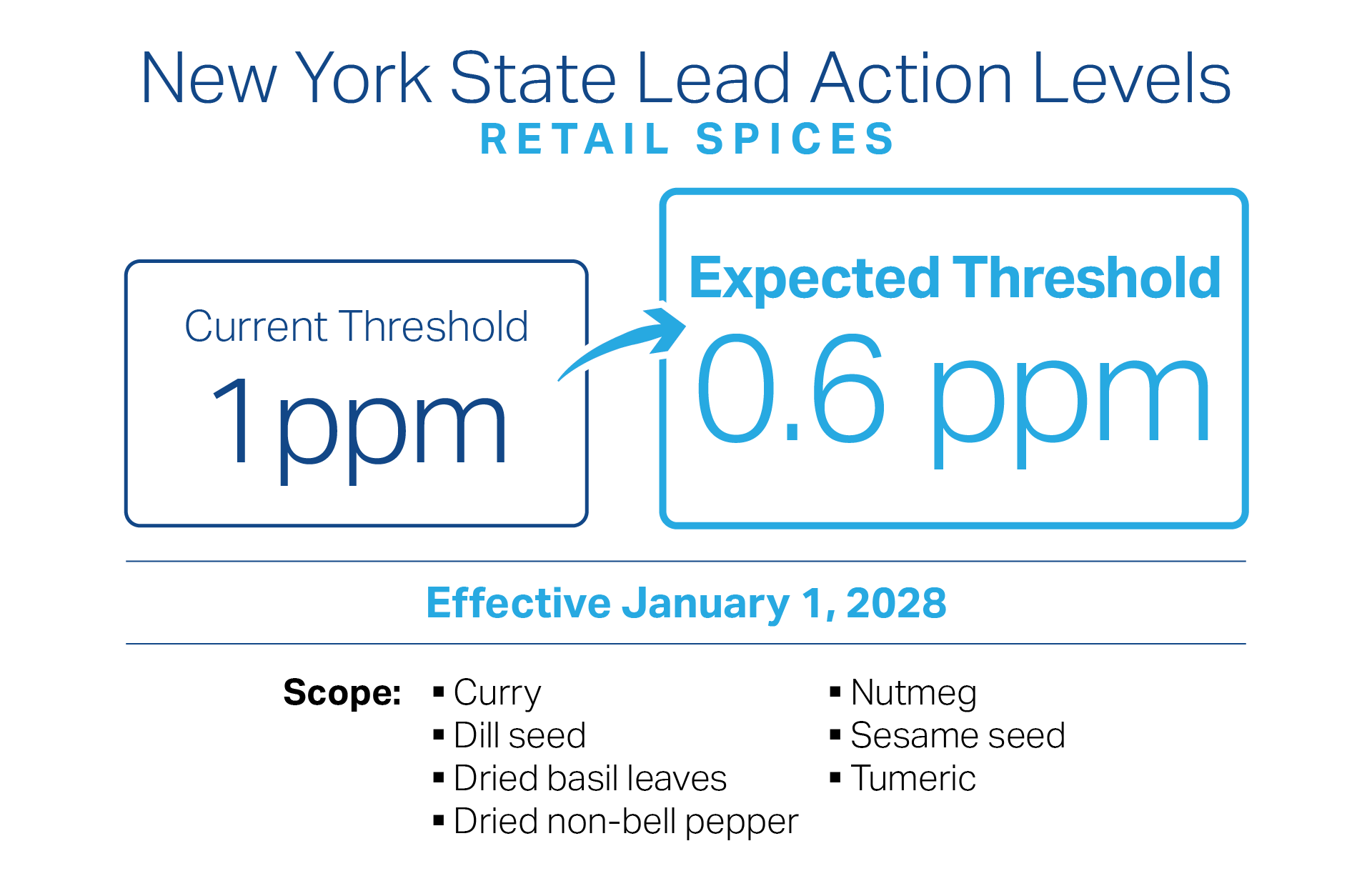
- New York State announced a reduction in the lead action level to 0.6 ppm for certain retail spices sold in the state, effective Jan. 1, 2028.
- The affected spices are curry, dill seed, dried basil leaves, dried non-bell pepper, nutmeg, sesame seed, and turmeric.
- According to ASTA’s analysis, most affected spices can already meet the proposed limit, but lot-to-lot variation still creates compliance and recall risk.
- Importers and manufacturers should begin confirmation testing now to verify supplier COAs, document due diligence, and protect their brands.
New York Lead Action Levels in Spices to Drop to 0.6 PPM on Jan. 1, 2028
New York State announced on June 5, 2026 that it is reducing lead action levels for certain retail spices sold in the state. The new level will be 0.6 ppm, effective Jan. 1, 2028. New York currently maintains a 1 ppm threshold that triggers a recall in the state.
Importers, processors, private label brands, and manufacturers should start building lot-level and supplier-level lead data now through analytical chemistry testing of your raw materials and finished goods to avoid scrambling at the last minute.
We provide guidance in our FAQ.
What Spices are Affected by the New York State Lead Action Levels?
The proposed New York State action level applies to these retail spices:
- Curry
- Dill seed
- Dried basil leaves
- Dried non-bell pepper
- Nutmeg
- Sesame seed
- Turmeric
The key compliance threshold is 0.6 ppm lead, equal to 600 ppb.
When Does the New 0.6 PPM Action Level Take Effect?
The expected effective date is Jan. 1, 2028.
Companies should use the time before 2028 to evaluate suppliers, review historical lead data, identify higher-risk origins or matrices, and begin routine verification testing.
Are Other Spices Affected?
Other spices' Class II action level will remain 1 ppm. The New York State Department of Agriculture and Markets (NYS AGM) is still pursuing the ultimate goal of a limit of 0.21 ppm for inorganic arsenic, cadmium, and lead in spices, meaning this is a stepwise approach toward its goal of further reductions.
Is this a Federal FDA Limit?
No. The 0.6 ppm action level is a New York State requirement, not a federal FDA limit.
That said, FDA remains active on lead in spices. FDA has conducted targeted sampling of ground cinnamon for lead, recommended recalls for products with elevated lead, and stated that manufacturers and importers are responsible for ensuring the safety of products entering the U.S. market.
Why is New York State Reducing Limits on Lead in Spices?
Certain spice crops and spice plant parts can present elevated risk. Heavy metals may enter spices through environmental contamination during growth, contact with contaminated soil or dust, irrigation water, drying and processing conditions, or adulteration. Because spices are dried and highly concentrated, even low-level contamination can become more significant in the finished ingredient.
As such, spices are often of high concern regarding potential lead contamination.
What Should Importers and Manufacturers Do Now?
An America Spice Trade Association (ASTA) analysis indicates that most affected spices can already meet the proposed 0.6 ppm lead limit, with achievability rates ranging from 86% to 100% depending on the spice.
That is encouraging, but it does not remove compliance risk. Lead results can vary by supplier, origin, crop year, lot, and processing conditions.
Importers and manufacturers should begin confirmation testing to:
- Verify supplier COAs
- Establish baseline data by matrix and supplier
- Identify higher-risk lots before 2028
- Document due diligence
- Reduce the risk of regulatory action, customer rejection, or recall
Even when a supplier appears compliant, independent testing helps protect your brand before product reaches the market.
Can Supplier COAs Be Used?
Yes, but they should not be the only control.
Importers and manufacturers should periodically verify supplier data through independent lab testing. This is especially important for new suppliers, new origins, and products intended for retail sale in New York.
How Do Food Safety Labs Test for Lead in Spices?
Food testing labs typically test for lead in spices using trace metals methods. The general process includes sample homogenization, acid digestion, instrumental analysis, quality control checks, and reporting in ppm or ppb.
Common technologies include ICP-MS and ICP-OES, depending on the target reporting limit, matrix, and method requirements. We explain in detail how to test for heavy metals in food here.
For compliance planning, the most important points are that the method is validated for the spice matrix, the reporting limit is low enough for the action level, and the report clearly identifies the result, units, method, and reporting limit.
Can Certified Group Testing Meet New York State Lead Action Levels in Spices?
Yes. Certified Group has validated methods for all affected spices, with reporting to 0.010 ppm, far lower than the required 0.6 ppm action level.
Certified Group is an ASTA member and has deep analytical testing expertise for spices, including heavy metals testing to support supplier verification, import compliance, lot release, and regulatory response.
Certified Laboratories is a Certified Group company; contact us for lab testing of lead or other heavy metals in your spices.
