
 Matt Traynor, PhD
Matt Traynor, PhD
Matt Traynor, PhD
1-Minute Summary
- On June 9, 2026, FDA finalized approval of Bemotrizinol and deemed it a safe and effective active ingredient in U.S. sunscreens.
- Globally used in sunscreens, Bemotrizinol offers broad-spectrum protection, high photostability, and low skin absorption.
- Certified Laboratories offers a validated method for both Bemotrizinol and Bisoctrizole – one of the first in the U.S.
- Manufacturers can now formulate SPF products for sale in the U.S. that use Bemotrizinol.
U.S. Sunscreen Options Change for the First Time in 20 Years
For decades, U.S. sunscreen innovation has lagged behind global markets. While Europe, Asia, and Australia have long used next-generation UV filters like Bemotrizinol and Bisoctrizole, U.S. formulators had remained limited to an aging list of approved actives.
But that has all changed.
On June 9, 2026, FDA added bemotrizinol to the list of permitted sunscreen active ingredients, a move that will reshape the future of American sunscreen formulations. If you’re a manufacturer of SPF products, now is the time to take advantage and bring to market SPF products with this new (to the U.S.) UV filter technology.
A Quick Breakdown of Bemotrizinol and Bisoctrizole
So, why the fuss over this new UV filter?
Bemotrizinol (also known as Tinosorb S or PARSOL Shield) is an advanced, oil-soluble UV filter that absorbs both UVA and UVB rays. It’s been widely used in Europe and Asia for over two decades. The same goes for Bisoctrizole (Tinosorb M), a hybrid UV filter that works by absorbing, scattering, and reflecting UV radiation.
However, for years, neither compound was currently approved in the U.S. as an active ingredient in over-the-counter (OTC) sunscreens.
The U.S. regulatory pathway for Bemotrizinol began to clarify a couple years ago.
In October 2024, DSM-Firmenich submitted an OTC Monograph Order Request (OMOR) to the U.S. FDA seeking approval of Bemotrizinol as a GRASE (Generally Recognized as Safe and Effective) sunscreen active. The FDA sought public comments prior to its landmark decision in June 2026.
Why Bemotrizinol Sunscreen Is a Game-Changer
There’s a reason Bemotrizinol sunscreen is the go-to choice in global formulations, and now likely will be in the U.S.
1. Broad-Spectrum Power
With dual absorption peaks around 310 nm (UVB) and 340 nm (UVA), Bemotrizinol offers robust, long-lasting coverage across the spectrum. This enables high SPF ratings with lower overall concentrations.
2. Photostability
Unlike avobenzone, which quickly degrades in sunlight, Bemotrizinol holds strong. Even better, it stabilizes less photostable filters, improving the durability of your entire formulation.
3. Skin-Friendly and Safe
It’s virtually water-insoluble and has a large molecular size, limiting dermal penetration. That translates to low systemic absorption and minimal irritation, making it a preferred choice for sensitive skin products. Unlike mineral-based active ingredients, Bemotrizinol is a non-mineral active and doesn’t leave a white cast on the skin, which users often prefer.
4. Formulation Flexibility
Its oil-soluble nature works beautifully in emulsions and creams, pairing well with other organic filters or mineral actives like zinc oxide.
Bisoctrizole: A Strong Companion, With U.S. Limitations
Bisoctrizole, or Tinosorb M, brings its own advantages. It’s a particulate filter that’s both organic and inorganic in nature. Water-dispersible and photostable, it provides excellent coverage and often appears alongside Bemotrizinol in international products.
However, in the U.S., Bisoctrizole still cannot be marketed as an SPF active. It may be used as a cosmetic UV absorber – say, in tinted moisturizers or primers – but any SPF claim must come from approved actives. So while it’s a helpful supporting filter, it can’t lead the charge like Bemotrizinol could.
Market-Readiness Will Take Time
Even with FDA approval, it will take time before these products hit store shelves. Manufacturers will need to update formulations, test for stability, validate claims, and comply with labeling and GMP requirements.
For manufacturers, the time is now to prepare your new SPF products for U.S. markets.
How to Prepare Your Bemotrizinol Sunscreen Formulations
We recommend manufacturers begin research and development immediately:
- Formulation development can take 6–12 months.
- Raw material sourcing must be vetted and secured in a volatile market.
- SPF efficacy, in-package stability, and preservative efficacy testing must be planned and executed.
- Label and regulatory reviews will be required after approval.
Forward-thinking brands that start now can be first to the U.S. market with an SPF product that’s more appealing to consumers.
Certified Laboratories Has Validated Methods for Bemotrizinol and Bisoctrizole
Formulators often face a hurdle: testing. Fortunately, Certified Laboratories has a solution.
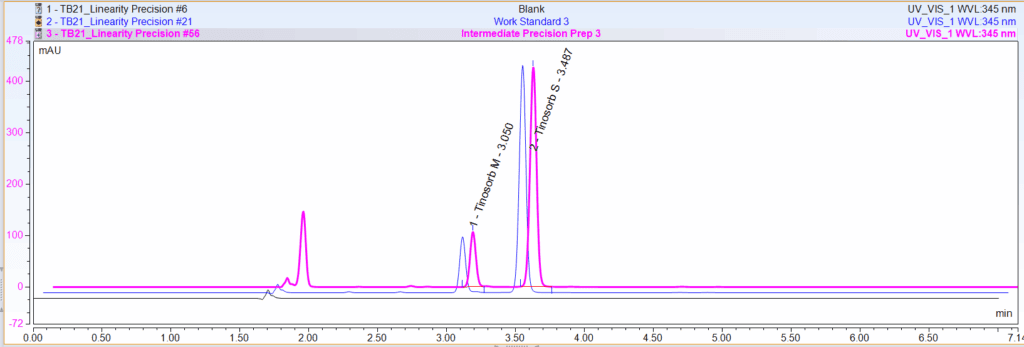
We are proud to be one of the first U.S. laboratories with a validated method for both Bemotrizinol and Bisoctrizole, also known as Tinosorb S and Tinosorb M. See the validation data for our Tinosorb testing method here.
Our method offers…
- 7-minute run time per analysis, ensuring high throughput and fast turnaround.
- Compliance with ICH Q2(R2) guidance, helping ensure reliability and regulatory alignment.
- Dual-analyte capability, analyzing both Bemotrizinol and Bisoctrizole in a single run.
Whether you’re developing a Bemotrizinol sunscreen, a hybrid formula using Bisoctrizole, or a product for global distribution, our lab is ready to help.
Contact Us Today
If you’re formulating with Bemotrizinol, Certified Laboratories can test your samples using validated, reliable methods.
