
 Certified Laboratories
 Matt Traynor, PhD
1-Minute Summary
- Phthalates can enter cosmetic, dietary supplement, and plastic products through certain ingredients, raw materials, processing components, or packaging.
- Health concerns vary by phthalate and exposure. Several phthalates are associated with reproductive or developmental toxicity; some are listed under California Proposition 65.
- Validated phthalates testing can help substantiate a carefully defined “phthalates-free” claim, with suitable reporting limits and evidence appropriate to the product and claim.
- Certified Laboratories validated a GC-MS/MS method for 12 phthalates using a cosmetic product and plastic object, with calculated detection limits (LODs) of 0.013–0.605 ppb and quantitation limits (LOQs) of 0.044–2.018 ppb.
Consumers are Wary of Phthalates in their Products
Consumer scrutiny of cosmetic ingredients is increasing. A May 2026 YouGov survey found that 78% of U.S. adults were concerned about ingredient safety in products such as food, cosmetics, and personal care items. In an October 2026 survey of 1,700 members of OnSkin’s cosmetics-consumer community, 33% said they avoid phthalates.
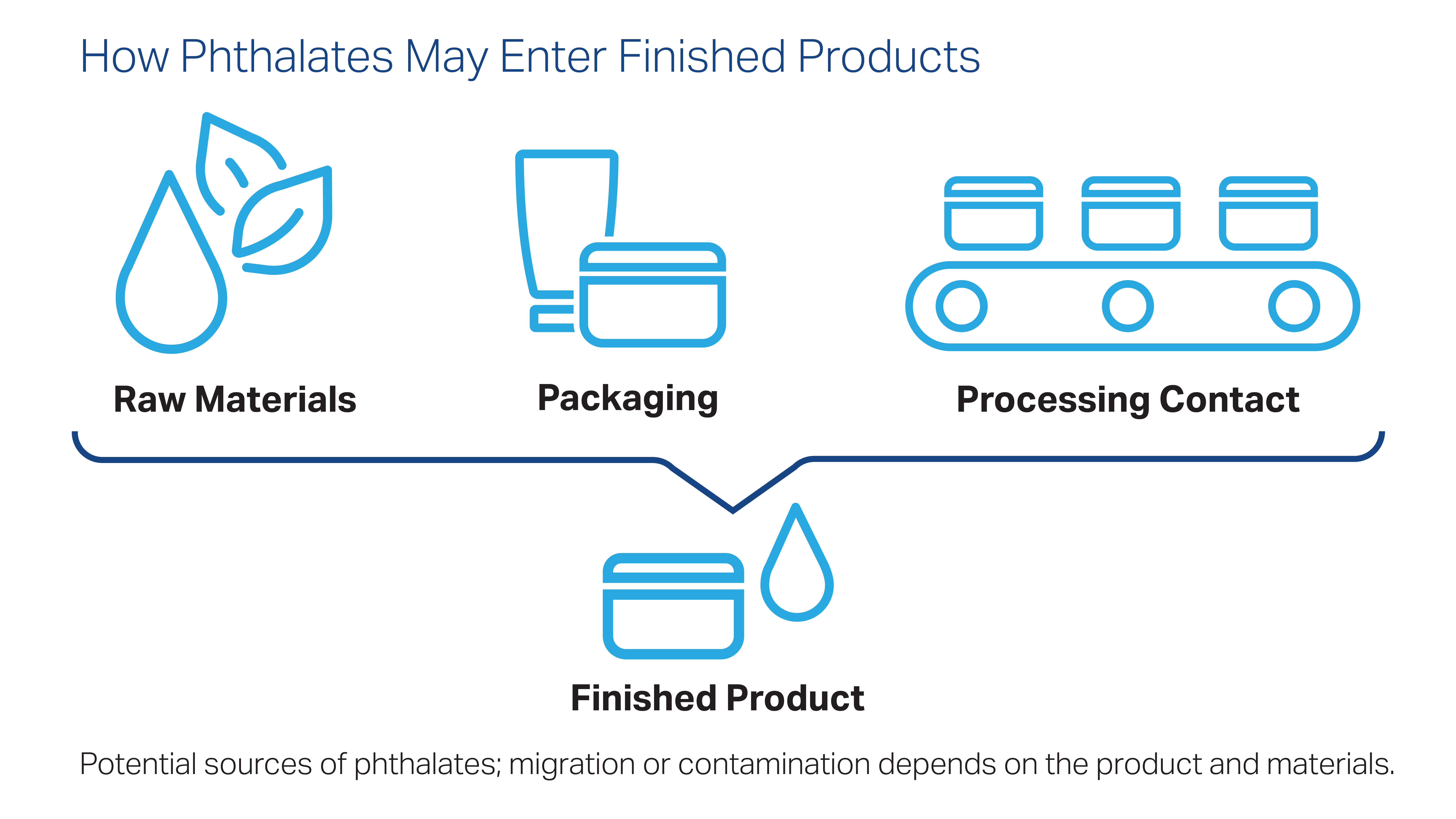
That concern has practical consequences for manufacturers. In August 2026, Chemical & Engineering News reported on a study of 113 personal care and cleaning products that detected phthalates in some items labeled “phthalate-free.” Phthalates are used to make materials such as PVC flexible, and some are used in fragrance formulations. Certain phthalates can also migrate from packaging or processing materials into a finished product, depending on the materials, formulation, storage conditions, and contact time.
For manufacturers, this raises three questions:
- Which phthalates should we monitor?
- Can the chosen phthalates testing method detect them reliably in the product matrix?
- Can the resulting data support quality, regulatory, and label-claim decisions?
Where Phthalates May Appear in Cosmetics, Supplements, and Plastic Products
Cosmetics and Personal Care Products
Potential sources include fragrance materials, certain historical ingredient uses, and contact with packaging or processing materials.
Cosmetics can be analytically complex: oils, surfactants, emulsifiers, fragrances, and preservatives may complicate extraction and detection. FDA identifies diethyl phthalate (DEP) as a phthalate still used in some cosmetics, particularly fragrances; its assessment also notes that it does not currently have evidence that phthalates as used in cosmetics pose a safety risk.
Even so, consumers are still actively avoiding products that contain phthalates, as the consumer data cited in the opening section show.
Dietary Supplements
Capsules, gummies, powders, and liquid supplements may come into contact with bottles, closures, liners, processing materials, or other components over their shelf life. Phthalate migration is not inevitable in every package; testing can help investigate a potential source or evaluate a specific packaging change. Finished-product results may be useful alongside packaging compatibility studies and supplier documentation.
Regulatory scrutiny of food-contact materials reinforces the importance of understanding possible migration routes. In May 2026, FDA published a scientific evaluation of eight phthalates authorized for certain food-contact uses and proposed grouping four for a future cumulative risk assessment. This was an assessment step and is evidence of continuing regulatory attention to phthalates.
Plastic Products
Phthalates are commonly used as plasticizers in certain plastics, particularly flexible PVC, to improve flexibility and durability. Because these additives are not chemically bound to the plastic, they can migrate out of the material over time. For manufacturers of toys, consumer accessories, and other plastic products, including certain adult-use products, phthalates testing can help identify potentially harmful compounds in raw materials and finished products, verify supplier specifications, and support compliance with applicable product safety requirements.
For children’s toys and child care articles, separate federal requirements apply. The Consumer Product Safety Commission (CPSC) restricts eight specified phthalates to no more than 0.1% (1,000 ppm) in applicable accessible components.
What Are the Health and Regulatory Concerns?
The potential health effects of phthalates are compound-specific. EPA notes concerns about toxicity and widespread exposure, with effects on male reproductive development among the most sensitive outcomes reported in animal studies. Some human studies have reported associations, but associations do not necessarily establish that a particular consumer product causes harm.
California Proposition 65 lists several phthalates. For example, DEHP is listed for cancer and reproductive toxicity, while DBP and butyl benzyl phthalate (BBP) are listed for reproductive toxicity.
Proposition 65 warning obligations generally depend on exposure to a listed chemical and the relevant route and level of exposure, not simply whether a product contains a detectable amount. Laboratory concentration data can support an exposure assessment, but a positive result alone does not determine whether a warning is required.
Similarly, the federal 0.1% toy limit is a restriction for specified phthalates in covered children’s products. It is not a general safety threshold for every cosmetic, supplement, plastic article, or “phthalates-free” claim.
Can Phthalates Testing Support a “Phthalates-Free” Claim?
Yes. A validated analytical phthalates testing method can provide important scientific evidence, but testing results must be interpreted in the context of the exact claim. A result of “not detected” means the specific analytes were not detected at the method’s detection or reporting limits; it does not establish that every phthalate is absent at any concentration.
Before making a “phthalates-free” claim, manufacturers should define the phthalates covered, evaluate raw materials and packaging, confirm that the method is suitable for the finished-product matrix, and document the relevant analytical limits. FTC guidance also requires objective marketing claims for health-related products to be truthful, not misleading, and adequately substantiated.
Our Approach: A Validated GC-MS/MS Phthalates Testing Method
Certified Laboratories developed and validated an analytical test method for phthalates detection and quantification in cosmetic, supplement, and plastic matrices. The method uses gas chromatography coupled with tandem mass spectrometry (GC-MS/MS) to detect and quantify 12 target phthalates in a single analytical procedure.
The validated 12-phthalate panel includes:
- Dimethyl phthalate (DMP)
- Diethyl phthalate (DEP)
- Diisobutyl phthalate (DIBP)
- Dibutyl phthalate (DBP)
- Bis(4-methyl-2-pentyl) phthalate (BMPP)
- Bis(2-ethoxyethyl) phthalate (DEEP)
- Dipentyl phthalate (DPP)
- Dihexyl phthalate (DHXP)
- Butyl benzyl phthalate (BBP)
- Dicyclohexyl phthalate (DCHP)
- Bis(2-ethylhexyl) phthalate (DEHP)
- Di-n-octyl phthalate (DNOP)
We validated the method with a cosmetic product and a plastic product. Other product matrices can be assessed through feasibility work or matrix-specific verification.
We adapt sample preparation to the product material and use GC-MS/MS to selectively identify and measure the target phthalates. Our analytical procedures also minimize background contamination, an important consideration when measuring compounds that may occur at trace levels.
Specificity: Can the Method Distinguish the Target Phthalates?
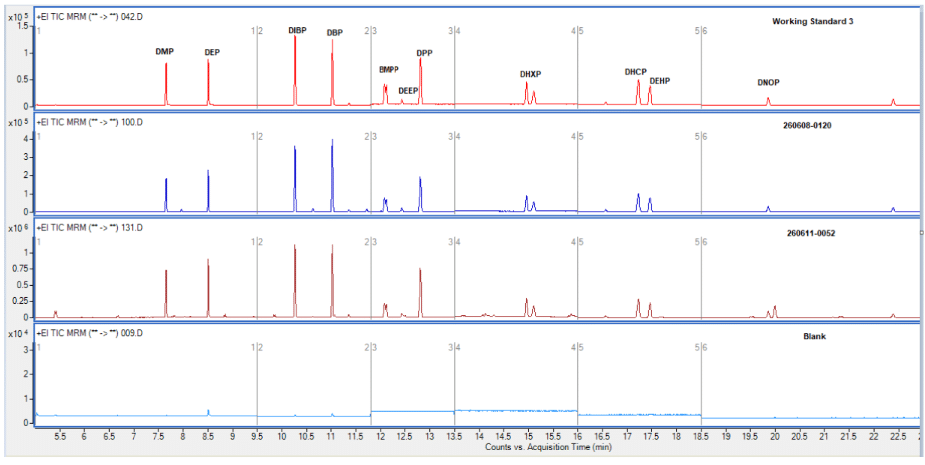
Phthalates testing methods must distinguish target compounds from sample components and background contamination. In the validation, we compared solvent blanks, calibration standards, and representative matrix extracts. The specificity and system suitability criteria passed.
Some phthalates, including DEP, DIBP, and DBP, are so widespread that trace background signals may appear even in controlled laboratory conditions. During our validation, these signals remained below the lowest calibration standard. Our contamination controls and reporting limits help distinguish meaningful results from background.
These chromatograms compare a blank, a known phthalate standard, and samples from the cosmetic product and plastic object. The target peaks are distinguishable from other signals, showing that thae method can identify the phthalates without interference from the matrices evaluated.
Linearity and Sensitivity: How Low Can the Phthalates Method Measure?
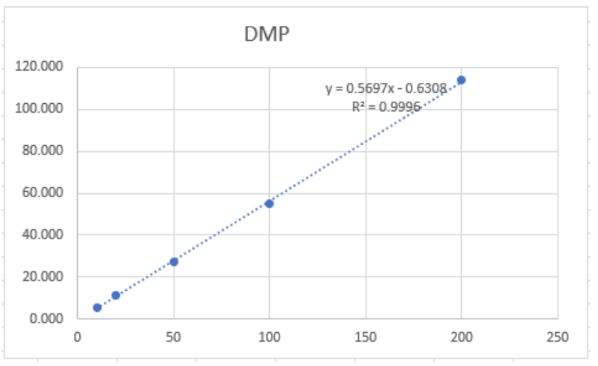
The method used a five-point calibration from 10 to 200 ppb for each of the 12 phthalates. All analytes met the predefined linearity criterion (r² ≥ 0.99), and check-standard recovery also met the acceptance criteria.
The graph shows how the response for dimethyl phthalate (DMP) changes as its concentration increases. The five calibration points closely follow a straight line, demonstrating a consistent response across the tested range.
Our calculated limits of detection (LODs) range from 0.013 to 0.605 ppb, and limits of quantification (LOQs) range from 0.044 to 2.018 ppb, depending on the phthalate. These indicate how low the method can detect and measure the compounds in analytical solutions. Reporting limits for a finished product may vary by matrix.
| Measure | Calculated Range (ppb) | Meaning |
| LOD | 0.013–0.605 | Lowest detectable level |
| LOQ | 0.044–2.018 | Lowest quantifiable level |
Accuracy and Precision: How Consistent Are the Results?
Accuracy was examined using spiked preparations of the cosmetic product and plastic object at multiple concentrations. Both representative matrices met the predefined recovery criterion of 65%–135% and the repeatability criterion of no more than 25% relative standard deviation (RSD).
Precision was evaluated using six preparations per analyst at the target level, with two analysts involved. The study met its criteria for individual-analyst performance and combined intermediate precision (no more than 30% RSD). These results support consistent measurements under the conditions studied; any substantially different sample matrix may still require a suitability assessment.
| Performance Characteristic | Acceptance Criterion | Result |
| Accuracy | 65%–135% recovery | Pass |
| Repeatability | RSD ≤25% | Pass |
| Intermediate precision (two analysts) | RSD ≤30% | Pass |
Two Phthalates Testing Method Details That Help Maintain Reliable Results
During validation, we saw firsthand the importance of temperature. Changes to the mass spectrometer’s source temperature affected measurement accuracy. We maintain the validated temperature during routine testing and repeat an analysis if that setting deviates.
Fresh preparation matters, too. Our stability work showed that samples and working standards should be prepared on the day of analysis rather than stored for later use. With these practical controls in place, the phthalates analytical method met its intended-purpose validation criteria.
Using Phthalates Analysis to Make Better Quality Decisions
For cosmetic, dietary supplement, and plastic-product manufacturers, a fit-for-purpose phthalates testing program can help:
- Screen selected raw materials or evaluate supplier changes.
- Investigate suspected packaging migration or manufacturing contamination.
- Assess finished products using an analytically appropriate matrix and reporting limit.
- Generate supporting evidence for carefully qualified phthalates-free claims.
- Provide concentration data to inform a Proposition 65 exposure evaluation or other applicable regulatory review.
Certified Laboratories’ validated GC-MS/MS phthalates testing method provides a scientifically documented starting point for these decisions, with method suitability evaluated for the submitted product.
Contact our team to discuss your formulation or material, the target analytes, and the testing approach appropriate to your quality or compliance objectives.
