
 Certified Laboratories
Reviewed by Steven Rogers, Corporate Quality Manager, Certified Group; and Kevin Schmitt, Technical Services Specialist, Certified Group
1-Minute Summary
- Changing temperatures, drought, and rainfall may shift mycotoxin risks into new growing regions.
- Mycotoxins can occur in grains, nuts, coffee, fruit products, and ingredients used in pet food—and some survive processing.
- Testing for only one familiar mycotoxin may miss other hazards associated with an ingredient.
- Manufacturers and importers should review sourcing, crop conditions, sampling, and testing plans; mycotoxins can also lead to FDA import detention.
What the Data Tell Us About Changing Mycotoxin Risks
Most food manufacturers know mycotoxins can be a problem in crops such as corn, grains, nuts, and fruits. What's changing is the climate in which these crops grow.
Hotter seasons, extended drought, and bursts of heavy rain can change the conditions in which certain molds grow. For QA teams, that raises the question…
Is your mycotoxin testing program still looking for the right hazards?
EFSA reports that warmer temperatures and humidity likely contributed to aflatoxins emerging in southern Europe in the early 2000s and spreading northward.
The concern extends beyond Europe. A 2026 study involving USDA Agricultural Research Service researchers found that fumonisin risks and associated fungal diseases occur across a broad range of North American corn-growing environments. The researchers also found that temperature conditions influence which fungal diseases are more prevalent.
A recent global feed survey highlights another testing challenge. From January through September 2026, dsm-firmenich analyzed 16,244 samples from 75 countries. Among samples tested for three or more mycotoxins, 83% contained multiple mycotoxins.
The survey underscores why testing programs should consider multiple mycotoxins. As climate change alters growing conditions, manufacturers may need to reassess which toxins their testing panels target—not just how frequently they test.
What Are Mycotoxins and Why Do They Matter?
Mycotoxins are toxic compounds produced by certain molds. They may develop in crops before harvest or during storage, and some remain in food even after processing.
Contamination is not always visible. Depending on the toxin and exposure, potential effects in people and animals include digestive illness, liver or kidney damage, immune or reproductive effects, and cancer.
How Can Changing Weather Affect Mycotoxin Risks?
Temperature, moisture, and crop stress all influence whether mycotoxin-producing fungi can grow and produce toxins. Climate change may alter these conditions in several ways:
- Heat and drought: High temperatures and water stress can weaken crops, particularly corn, making them more vulnerable to Aspergillus fungi that produce aflatoxins.
- Heavy rainfall and humidity: Wet conditions during critical growth stages, such as flowering, can encourage Fusarium infections and production of deoxynivalenol (DON), particularly in wheat.
- Increased insect activity: Warmer conditions may expand insect populations, creating crop damage that allows fungi to enter.
- Post-harvest conditions: Higher temperatures and moisture during drying, transportation, or storage can encourage fungal growth and toxin production.
The European Environment Agency reports that these climate-related changes may increase mycotoxin contamination and introduce risks into previously less-affected growing regions.
Which Ingredients Deserve a Closer Look for Mycotoxin Testing in Food?
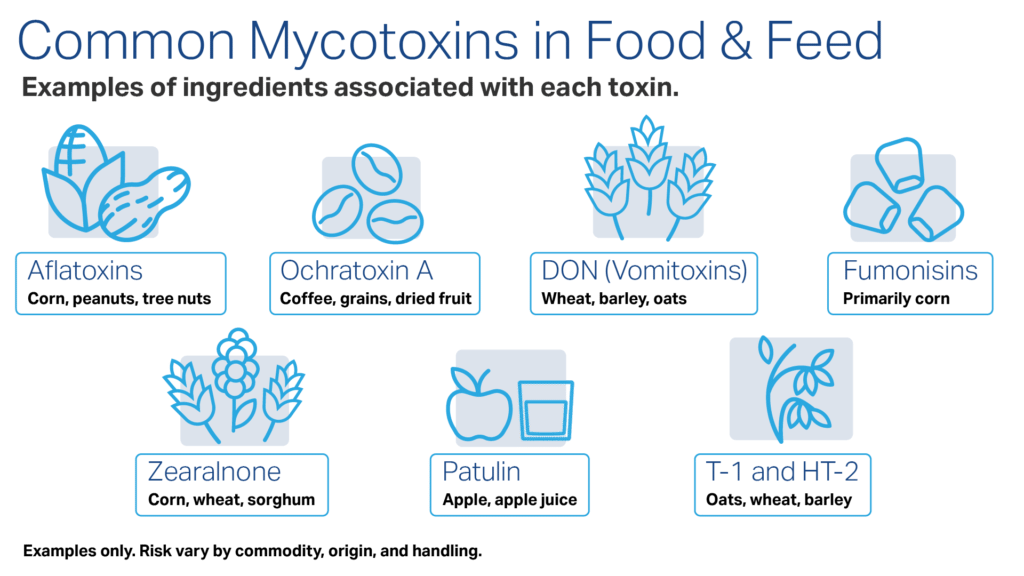
The mycotoxins to consider depend on the ingredient. Common examples include:
- Corn and other grains: Aflatoxins, fumonisins, DON, and zearalenone, depending on the crop.
- Peanuts and tree nuts: Aflatoxins.
- Coffee: Ochratoxin A can occur in coffee beans and coffee products, with drying and storage conditions influencing risk.
- Certain dried spices: Ochratoxin A is a concern in products such as paprika and chili powder.
- Certain dried fruits: Raisins, sultanas, and dried figs are examples of products associated with ochratoxin A.
- Apples and apple juice: Patulin.
- Pet food: Grain-based and other agricultural ingredients can carry mycotoxins into finished products.
Where ingredients are grown and how they are harvested, dried, shipped, and stored can matter as much as the ingredient itself.
When Should Manufacturers Reassess Mycotoxin Testing in Food Samples?
Food mycotoxin testing should follow the hazards associated with each ingredient, rather than treating every lot or product the same. Review your current program when conditions change:
- Have sourcing regions or growing-season conditions changed?
- Does the lab’s test panel cover the toxins associated with each ingredient?
- Do supplier controls, certificates of analysis, and previous results still support your testing frequency?
- Are you collecting representative samples? Mycotoxins can be unevenly distributed within a lot.
- What is your plan when a raw material or finished product exceeds an applicable limit?
Use those answers to refine raw-material and finished-product testing where it adds value.
What Does the FDA Require?
FDA has established action levels for certain mycotoxins, including 20 ppb for total aflatoxins in foods and 50 ppb for patulin in apple juice products. FDA also lists an advisory level for DON and recommended maximum levels for fumonisins. The applicable criteria depend on the commodity and intended use.
For importers, contamination may delay shipments. FDA Import Alert 23-14 allows detention without physical examination of certain listed food products and firms because of mycotoxins.
Routine mycotoxin testing generally does not require LAAF accreditation. However, FDA requires LAAF-accredited laboratory testing in certain import-related situations. Under Import Alert 23-14, this includes testing used to support admission of a detained shipment or removal of a product or firm from the alert through consecutive testing. The laboratory must be LAAF-accredited, such as Certified Laboratories, for the relevant analysis. Learn more about Certified Laboratories' FDA detention testing services.
Make Sure Your Testing Program Fits Today's Risks
A mycotoxin plan that worked in the past may still work today. But changing crop conditions, ingredient origins, and storage practices are good reasons to revisit it.
Certified Laboratories can help food and pet food manufacturers and importers identify relevant mycotoxins and develop targeted testing for ingredients and finished products. Contact us to discuss your program.
