
Howie Bogner had worked at Certified Laboratories for only a few months when someone told him the owner wanted to see him.
Martin “Marty” Mitchell had been traveling when Bogner joined the company to work in sample entry, so the two had never met. As Bogner walked toward Marty’s office, he assumed the worst.
“I’m like, ‘Oh my God, I’m gonna get fired,’” Bogner said. “Maybe I entered something wrong. Maybe I did something wrong.”
Marty asked him to sit down and quickly put him at ease.
“You didn’t do anything wrong,” he told him.
A customer simply needed their samples entered differently than Bogner had been taught. Marty knew the customer, understood their preferences, and personally explained the correct process to a new employee.
“He didn’t just sit in an office all day,” Bogner said. “He knew our clients personally and cared about their needs.”
The conversation showed Bogner what kind of owner Marty was. He understood the business from the smallest operational detail to its most complex scientific questions.
“I knew I was working in the right place because I had an owner that wasn’t disconnected from the business that he ran.”
That combination of involvement, scientific knowledge, and attention defined Marty Mitchell’s leadership of Certified Laboratories. He was a food scientist, entrepreneur, and industry advocate who helped transform a small New York laboratory into a national food-testing organization. He also became a mentor whose influence can still be heard in the words of the people who worked beside him.
As Certified Laboratories marks 100 years in 2026, Marty’s tenure stands as one of the most consequential chapters in its history.
Seeing What the Laboratory Could Become
Certified Laboratories was founded by Dr. Charles Paley in New York City in 1926 as a dairy testing laboratory. Dr. Bernard “Bernie” Tzall later became its second owner and expanded its consulting work.
Marty Mitchell entered the story in 1972, when he took over his family’s chemical and consulting business. The company supplied ingredients and guidance intended to help food manufacturers improve product quality and extend shelf life. Marty and Dr. Tzall eventually operated their businesses from the same building in Corona, Queens.
They recognized the opportunity to bring their capabilities together and formed a partnership during the 1970s. Marty gradually purchased Bernie’s shares until he became the owner of Certified Laboratories.
Soon after, in 1980, Ken Cusack joined the company doing sampling work. He later ran the traffic department, FDA import department, and seafood laboratory, becoming a respected seafood-quality expert before retiring in 2020.
Early in his career, Cusack traveled with Marty to production facilities and inspection sites, and that’s where he saw Marty’s character in action.
“I had a lot of good experiences with Marty, traveling with him,” Cusack said. “I learned everything. He taught me so much about production and inspections.”
Those trips taught Cusack how laboratory results connected to the realities of warehouses, processing plants, imported shipments, and regulatory requirements. Marty seemed to know people everywhere they went.
“He had a very large personality. In the industries that we were involved with, everyone knew Marty.” – Ken Cusack
“He had a very large personality,” Cusack said. “In the industries that we were involved with, everyone knew Marty.”
Under his leadership, Certified Laboratories expanded far beyond dairy testing.
“The lab expanded into flavors, spices, and imported foods as regulations became stricter about foods coming into the United States,” said Steven Mitchell, Marty’s son and eventual successor as company leader.
The company acquired other specialized New York laboratories, adding expertise in seafood grading and detecting the adulteration of valuable commodities such as vanilla and olive oil.
Of course, it required people in the lab to do the work – and Marty insisted that everyone was vital to the company’s success.
“For Marty, every job at the lab was important,” said Elizabeth Cusack, who emigrated from Colombia in 1982 and began working at Certified Laboratories as an Analyst two weeks later. “You could be cleaning the floor or you could be the CFO, but Marty made it known that every job was valued.” Elizabeth Cusack stayed at the lab her entire career, retiring as Chemistry Director in 2020.
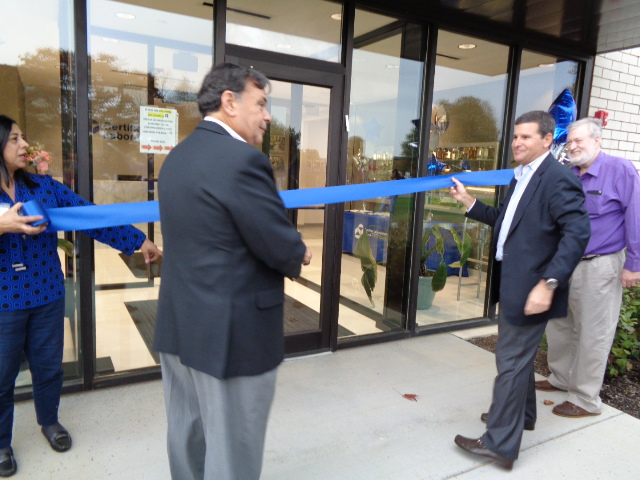
Martin and Steven Mitchell cut the ribbon to open the Certified Laboratories’ Melville, N.Y. lab. Elizabeth Cusack (left) and Ken Cusack (right) join them.
An Owner Who Knew the Work
Marty never treated ownership as a reason to distance himself from laboratory operations. When the food forensics and instrumentation departments temporarily lacked managers, he oversaw both while continuing to run the company.
“Here’s an owner of a company,” Bogner said. “He ran both departments and a business. Who does that in today’s world? He did it.”
He walked through the laboratory, asked employees what they were working on, and became involved when customers had technical problems.
Customers did not always hear what they wanted to hear. When one demanded results before the required test time had elapsed, Marty explained that the science could not be rushed.
“He didn’t lie to them,” Bogner said. “He didn’t come up with stories. He told them the truth.”
Pamela Galarza-Goedtel, Lab Services Supervisor – Food Forensics, learned the same lesson while reporting to Marty for ten years. When testing delays, complaints, or unexpected problems occurred, he told her to explain what happened honestly, speak with compassion, agree on a realistic completion date, and then deliver.
“Trying to cover it up or make excuses would only make it worse,” Galarza-Goedtel said. “I still think about that advice all the time.”
She has passed the lesson on to the people she now leads.
“The combination of science and service has always been what has made us a very strong company for 100 years,” Steven Mitchell said.
“He taught me that technical knowledge is only part of the job. Your reputation is built on honesty, accountability, and doing what you say you’re going to do.” – Pamela Galarza-Goedtel
High Standards and No Shortcuts
Marty expected a great deal from employees because he understood the stakes of food testing. An inaccurate result could contribute to the release of an unsafe product or lead a company to make the wrong decision.
“No business is easy, especially in a business where you get judged on calling balls and strikes correctly,” Steven Mitchell said. “If you have a reputation for not doing that or being inconsistent at that, you would never survive the test of time.”
“He made sure everything was done properly and according to the book,” said Ken Cusack. “No cutting corners.”
When problems arose, Marty expected people to address them rather than hide them. He stayed involved through careful review, correction, and late nights when the work required it.
Marty challenged Galarza-Goedtel to think through problems instead of simply handing her the answer. He expected her to own her decisions and do the right thing, even when it was difficult.
“He taught me that technical knowledge is only part of the job,” she said. “Your reputation is built on honesty, accountability, and doing what you say you’re going to do.”
His standards were high, but employees also saw him apply them to himself. He worked late, appeared on weekends, and joined calls with overseas customers at whatever hour was necessary.
“I love the business,” Bogner remembered him saying. “That’s why I come to work every day.”
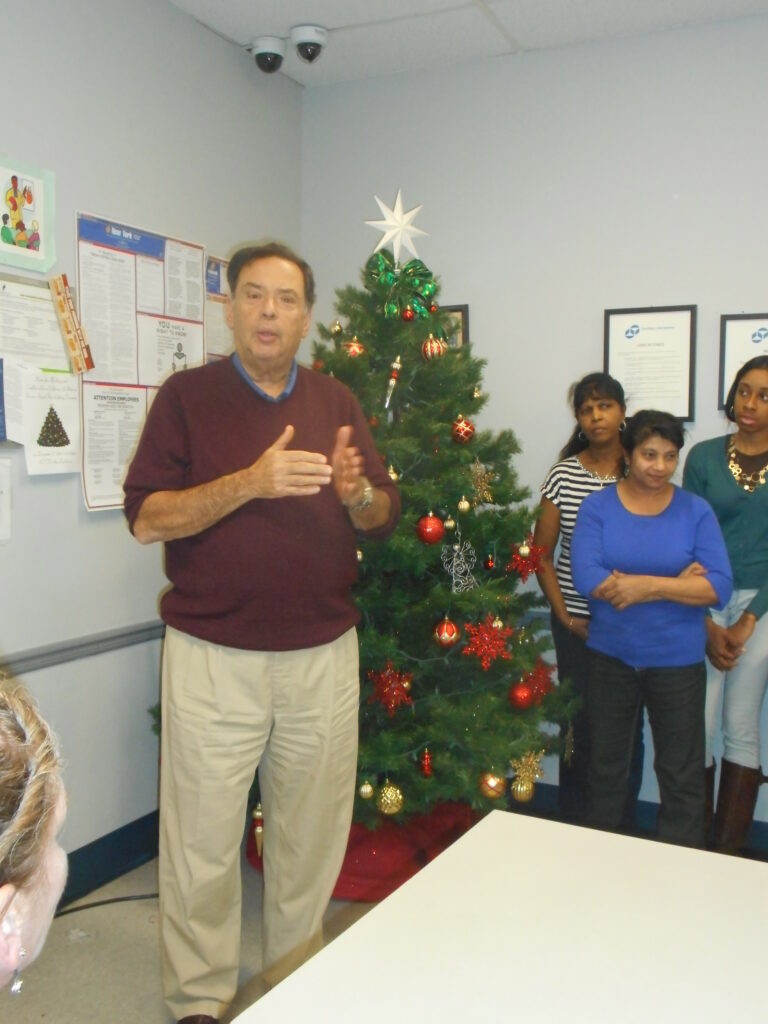
Marty Mitchell addresses the Certified Laboratories team during a holiday celebration.
A Teacher Who Built Careers
Before entering the food-testing business, Marty had worked as a teacher. Krisann Tallman, VP of Finance, believed he carried that instinct throughout his career.
“He loved that aspect of being a teacher and a mentor,” she said. “He also was interested in learning and expanding his knowledge, both technically and in a business realm.”
He looked for employees with potential, gave them responsibility, and invested in their development.
For example, Bogner did not enter Certified Laboratories with a formal scientific background. He began in sample entry and found his way into sensory analysis almost by accident. Marty waited until he was confident that Bogner was committed to the work, then paid for the training he needed to develop his skills.
“He spent the money to get me trained,” Bogner said. “He didn’t have to.”
Several years later, Marty called him into the office again. This time, he promoted him.
“I was stunned,” Bogner said. “I never expected that he would ever call me into his office for that reason.”
The promotion showed that Marty had been watching his progress.
“He knew everything that went on with what I was doing,” Bogner said. “He took me under his wing.”
Bogner went on to build a career in sensory analysis and food forensics that has lasted more than two decades.
“I owe my career to that man,” he said. “He took a chance on me.”
Galarza-Goedtel’s first meeting with Marty began with similar nerves. She arrived early for her interview and sat outside his office while he spoke with raised voice to someone. When the door opened, the employee walked out smiling and the receptionist told Galarza-Goedtel, “You’re up.”
“I was terrified,” she said.
The moment she entered, Marty greeted her warmly and put her at ease. Over the next ten years, she came to understand that first encounter as a picture of his leadership: passionate about the work and willing to hold people accountable.
Mohini Khan experienced that same faith in people after joining Certified Laboratories in 1998. She had recently come from Guyana and knew little about laboratory work. Marty regularly visited the lab and reassured her.
“Don’t worry, you’ll learn it,” he told her. “We’ll teach you everything.”
“He always made me feel like I could do it,” Khan said.
She has now spent 28 years in the Microbiology Department.
“I wouldn’t be where I am without him.”
Responding When the Industry Needed Answers
Marty’s curiosity kept Certified Laboratories alert to changes in food production, global trade, and regulation. He did not wait for a new requirement to become routine before acting. He wanted the laboratory to understand it early and develop the scientific capabilities customers would need.
“We were at the forefront working with these industry groups, trade associations, the FDA, the USDA, to be one step ahead of what the regulators would be looking for,” Steven Mitchell said.
That pattern began during his early years as owner. As regulations governing imported foods became more stringent, Marty expanded Certified Laboratories beyond its traditional dairy work into other areas.
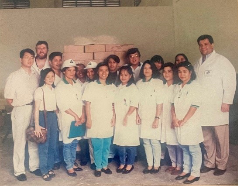
Martin Mitchell (far right) and Ken Cusack (back row, left) visited a seafood cannery in the Philippines, in 1996, in part to train their Quality Assurance team on food safety practices.
Spices became an especially important part of the laboratory’s work. Marty helped add analytical chemistry and filth analysis at a time when relatively few laboratories offered those capabilities.
“Bringing in the chemistry and filth side of the business allowed more work in spices and expanded the breadth of the business,” Tallman said. “He was fascinated with the analytical chemistry instrumentation and what that could do.”
The same instinct guided Certified Laboratories as FDA scrutiny of imported products increased. Bogner recalled Marty identifying new needs involving FDA detention work, antibiotic testing, and pesticide analysis.
“He saw something brand new in FDA detention, and he said, ‘We’ve got to figure this out,’” Bogner said. “He figured out with the instrumentation crew and his knowledge how to do this testing and bring it in. That was all Marty Mitchell,” Bogner said. “He would delve into these things.”
Those capabilities helped Certified Laboratories build a substantial import inspection and testing program during the 1990s and 2000s. The company invested in equipment, developed specialist personnel, and expanded its knowledge through workshops and direct experience with the industry. Steven Mitchell identified working with FDA to make imported seafood safer as one of the laboratory’s most important contributions to consumer protection.
Marty responded with the same energy when nutritional-labeling rules changed. He became involved in how Certified Laboratories would calculate, review, and report the required information.
“He just relished discussing the concept, the process, and how can we get there, and how can we satisfy our customers,” Tallman said.
The initial solution involved manual work and was not perfect, but waiting was not an option. Marty often expressed the principle as, “Perfection is the enemy of the good.” For him, progress meant developing a sound solution, putting it to work, and refining it as the laboratory learned more.
“How do we address this issue?” Tallman recalled. “It needed addressing now. We couldn’t wait.”
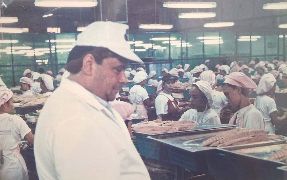
Martin Mitchell examines tuna at a cannery in the Philippines, in 1996. He played a significant role in advancing seafood safety across the globe.
A Lasting Influence on Food Safety
Marty became especially well known within the American Spice Trade Association. He served as an associate representative on ASTA’s Board of Directors and participated in technical, analytical-methods, science, and regulatory committees.
The association now presents the Marty Mitchell Outstanding Service Award to people who demonstrate exceptional commitment to advancing the spice trade through expertise, leadership, collaboration, and service.
Marty’s work with spices brought together microbiology, adulteration, filth, pesticide residues, imports, and analytical methods. Bogner often went into Marty’s office simply to learn.
“The impact of his technical expertise for the Refrigerated Foods Association and the industry cannot be overemphasized. But his impact on the lives and hearts of this organization was even more extraordinary.” – Megan Levin
“I really would just pick his brain,” he said. “All the knowledge I got, I got from him.”
Marty also served as technical director of the Refrigerated Foods Association beginning in 1981. Marty had originally been invited only as a speaker at the association’s first meeting. “After one presentation, the group realized they needed to hang on to this intelligent, articulate, personable young food scientist,” said Megan Levin, RFA Executive Director.
He was involved from the association’s earliest years, providing technical expertise and helping establish a culture of technical rigor and collaboration. He supported members with food-safety information, regulatory guidance, and practical training resources for refrigerated food plants.
“The impact of his technical expertise for the RFA and the industry cannot be overemphasized,” Levin said, “but his impact on the lives and hearts of this organization was even more extraordinary.”
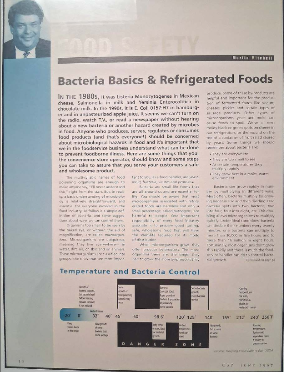
Martin Mitchell contributed to food safety in many ways, including through published technical articles, like this one from the June 1997 edition of CSP Magazine.
His service extended to the American Council of Independent Laboratories, the National Coalition of Food Importers Associations, and the Institute of Food Technologists’ Refrigerated and Frozen Foods Division. Colleagues also recall him traveling to Washington to advocate for food-safety oversight and the resources needed by regulatory agencies.
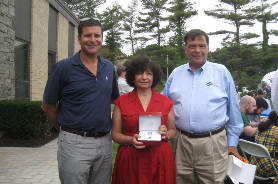
Steven Mitchell, Doris Munoz, and Martin Mitchell at Doris’ retirement party.
Loyal to the People who Shared His Commitment
Marty’s standards were demanding, but his loyalty was equally strong.
During a major storm that brought flooding, power outages, and damage to employees’ homes, Marty gathered the team.
“Don’t worry about your job,” he told them. “Go home and take care of your family.”
“Marty wasn’t just my boss,” Mohini said. “He was like family to me. It didn’t matter who you were – he made you feel important.”
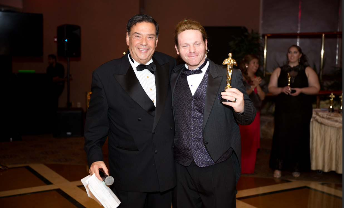
Martin Mitchell and Howie Bogner at a Certified Laboratories holiday party, one of many occasions that reflected Marty’s deep loyalty to his team.
Bogner saw the same loyalty when his mother became gravely ill. He went to Marty and asked him to pray for her.
“Howie, go home,” Marty said. “Take off as long as you need. I’ll take care of you.”
Ken Cusack said Marty established retirement benefits soon after the government developed the 401(k) program. Those decisions helped employees who spent their careers with Certified Laboratories build financial security and retire comfortably.
“Sometimes you won the argument; sometimes you lost. But he would always listen.” – Howie Bogner
Marty also kept his door open. Employees could raise concerns, disagree with him, and know he would listen.
“Sometimes you won the argument; sometimes you lost,” Bogner said, “but he always would listen.”
Marty’s message was simple.
“Don’t be afraid to come in if there’s a problem. Come talk to me.”
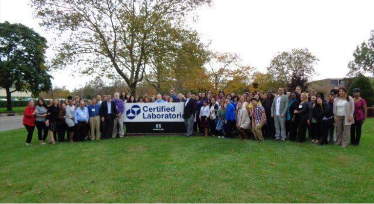
The Certified Laboratories team outside the Melville, N.Y., lab. Martin Mitchell stands to the right of the sign.
A Legacy Carried Forward by People
Marty helped broaden Certified Laboratories’ science, expand its reach, and strengthen its relationships with industries that depended on credible testing. But his most enduring influence may be found in the people he taught.
To Galarza-Goedtel, “Mr. Mitchell was the heart of Certified Laboratories.” She sees his influence in how employees treat clients, the standards they uphold, and the people he helped shape.
“He didn’t just help build Certified Laboratories,” she said. “He helped build the people who make it what it is today.”
“Beyond the vision of great leaders and innovators and entrepreneurs and scientists is the importance of the people at the bench,” Steven Mitchell said. “The art of the science is so heavily weighted on the abilities of our scientists and employees and associates. And it’s because of them that Certified is and will remain a great company.”
As we mark 100 years in 2026, Marty Mitchell’s story reminds us that the history of Certified Laboratories – and Certified Group – is the history of people who understood that accurate science could protect consumers they would never meet.
Marty expected accuracy because the stakes demanded it. He challenged employees because he believed they were capable of more. He served industry organizations because safer food required cooperation beyond the walls of one laboratory.
His standards remain part of the company he helped build. His name remains part of the industries he served. His influence continues through the people who still approach food safety with the seriousness, curiosity, and care he taught them.
