
 Matt Traynor, PhD
Matt Traynor, PhD
Matt Traynor, PhD
1-Minute Summary
- Tinosorb S, also known as bemotrizinol, received FDA approval for use in U.S. sunscreens on June 9, 2026.
- Tinosorb M, also known as bisoctrizole, is widely used internationally but is not approved as a U.S. OTC sunscreen active ingredient.
- Certified Laboratories developed a dual-analyte HPLC method for Tinosorb M and Tinosorb S to support SPF product development, quality control, and stability programs.
- The method validation evaluated specificity, system suitability, linearity, sensitivity, accuracy, precision, robustness, and solution stability.
- The validation results support a fit-for-purpose method for manufacturers working with advanced UV filter technologies.
Why Tinosorb Testing Matters for SPF Product Development
After decades of inactivity, SPF product development is finally changing in the U.S.
Bemotrizinol, also known as Tinosorb S or PARSOL Shield, is an advanced organic UV filter used internationally in sunscreen formulations. On June 9, 2026, FDA approved its use in U.S. sunscreen products, the first change to sunscreen options in 20 years.
Bisoctrizole, also known as Tinosorb M, is another next-generation UV filter used globally. It is a hybrid particulate filter that absorbs, reflects, and scatters UV radiation. Unlike bemotrizinol, it is not currently approved as an OTC sunscreen active ingredient in the U.S., but it’s still important for brands that sell in jurisdictions where it is permitted for use.
All of this is to say that there is a need for analytical chemistry methods to measure these two compounds during formulation screening, raw material evaluation, finished product testing, and OTC/cosmetic stability programs.
Certified Laboratories has developed and validated such a method that is intended for cosmetic and OTC matrices. Let’s dive into the science behind our method.
Why SPF Products are Difficult Analytical Matrices
First, the chemical complexity of SPF products makes sunscreen testing especially difficult.
A finished SPF product may contain…
- Oils
- Emulsifiers
- Waxes
- Polymers
- Preservatives
- Fragrances
- Film formers
- Pigments
- Mineral UV filters
- Multiple organic UV filters
These ingredients can create background signals, affect extraction, or interfere with chromatographic separation.
From an analytical chemistry perspective, the central question is whether the method can measure the correct compound accurately in a real product matrix.
A validated, fit-for-purpose method should answer several questions:
- Is the analyte peak free from interference?
- Is the response linear across the intended working range?
- Does the method recover the analyte accurately from the sample matrix?
- Can different analysts reproduce the result?
- Does the method remain reliable when normal method variables shift slightly?
Certified Laboratories validated its Tinosorb testing method to address these questions.
Our Approach: A Validated HPLC Method for Two UV Filters
Certified Laboratories developed a dual-analyte HPLC method for Tinosorb M and Tinosorb S. The method is designed to quantify both analytes in a single analytical run, supporting efficient Tinosorb testing for SPF product development and quality programs.
- 7-minute run time
- Dual-analyte capability
- Alignment with ICH Q2(R2) expectations
Let’s look at the method’s specificity, system suitability, linearity, accuracy, precision, robustness, and solution stability.
Specificity: Can the Method Measure the Right Compound?
Specificity is one of the most important characteristics for sunscreen testing.
A sunscreen matrix can contain many ingredients that absorb in similar regions or behave similarly during chromatographic analysis. If the method cannot distinguish the analyte from nearby interferences, the result may be biased.
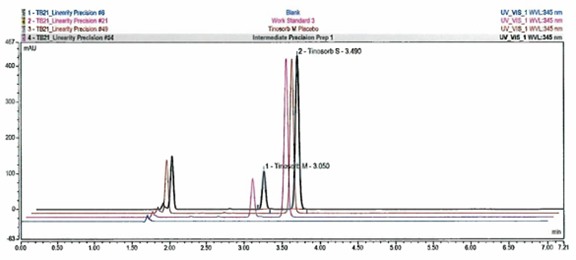
Certified Laboratories evaluated blanks, standards, placebo preparations, and samples. The validation showed no interference at the relevant retention windows for Tinosorb M or Tinosorb S, and retention time reproducibility met the predefined acceptance criterion.
For manufacturers, this supports confidence that the reported value represents the target compound, not an excipient, fragrance component, preservative, or another UV filter.
Overlay of Blank (Blue), 48 ppm Standard (Pink), Placebo (Garnet), and Sample (Black) for Tinosorb
Linearity: Does Response Track with Concentration?
Linearity shows whether detector response is proportional to analyte concentration across the method’s working range.
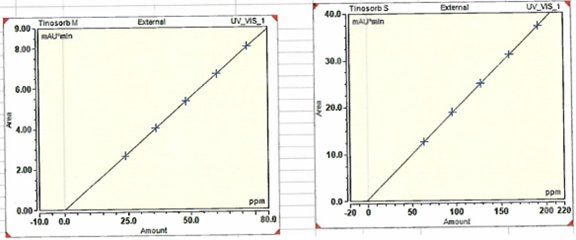
Certified Laboratories evaluated each analyte using a five-point calibration curve. Both Tinosorb M and Tinosorb S met the predefined linearity criterion, with coefficients of determination exceeding the acceptance threshold.
This matters during product development because manufacturers may test multiple prototype concentrations, formulation adjustments, and stability time points. A validated linear range gives technical teams confidence that changes in concentration are reflected accurately in the analytical result.
Linearity Curves for Tinosorb M and Tinosorb S Analytical Method Validation
| Linearity | |
| r2 ≥ 0.995 | Tinosorb M: 1.000 Tinosorb S: 1.000 |
| Recovery for check standard +/- 3% | Tinosorb M: 100.27% Tinosorb S: 100.07% |
| Overall Results: PASS | |
LOD and LOQ: How Low Can the Method Reliably Measure?
Our validation calculated limits of detection and quantitation using the calibration slope and standard deviation of response.
The validated method established low ppm-level sensitivity for both compounds:
- Tinosorb M: LOD approximately 0.32 ppm; LOQ approximately 0.98 ppm.
- Tinosorb S: LOD approximately 0.73 ppm; LOQ approximately 2.21 ppm.
Accuracy: Can the Method Recover the Analyte from the Product Matrix?
Accuracy is where method validation becomes especially practical.
As mentioned, SPF products can challenge extraction and quantitation because the analyte may interact with oils, waxes, emulsifiers, or other formulation components.
Certified Laboratories evaluated accuracy using spiked samples at three concentrations prepared and analyzed in triplicate. The method met predefined recovery criteria for both Tinosorb M and Tinosorb S.
| Accuracy | |
| % recovery for each injection shall be 95.0 – 105.0% | Tinosorb M level 1: 100.78%; level 2: 100.50%; level 3: 100.51% Tinosorb S level 1: 100.00%; level 2: 99.67%; level 3: 99.76% |
| % RSD for three injections per level shall be < 3.0% | Tinosorb M level 1: 0.04%; level 2: 0.25%; level 3: 0.09% Tinosorb S level 1: 0.05%; level 2: 0.06%; level 3: 0.09% |
| Overall Results: PASS | |
Recovery data are one of the best indicators that a method is fit-for-purpose. They show whether the sample preparation and analytical procedure can measure the analyte accurately in the presence of the product matrix.
Precision: Can the Method Be Reproduced?
Precision evaluates whether the method gives consistent results across replicate preparations and analysts.
Certified Laboratories tested precision using replicate sample preparations prepared by two operators. The method met predefined criteria for recovery, analyst percent RSD, and operator-to-operator agreement.
| Precision | |
| % recovery for each concentration shall be 90 – 110% | Tinosorb M: 101.69% Tinosorb S: 101.16% |
| % RSD of Operator A shall be < 2.0% | Tinosorb M: 0.34% Tinosorb S: 0.29% |
| % RSD of Operator B shall be < 2.0% | Tinosorb M: 0.57% Tinosorb S: 0.95% |
| % difference between Operators A and B shall be combined < 3.0% | Tinosorb M: 1.67% Tinosorb S: 0.67% |
| Overall Results: PASS | |
This is important because Tinosorb testing is not performed once, by one person, under ideal conditions. A method used for development, release testing, or stability support needs to be reproducible across trained analysts and normal laboratory workflows.
Robustness and Solution Stability: Can the Method Handle Normal Variation?
Robustness evaluates whether small, deliberate changes affect method performance.
Certified Laboratories challenged the method by evaluating controlled changes to organic content and column temperature and comparing results to the original control conditions. The validation report concluded that the method met predefined robustness criteria for both analytes.
The report also evaluated refrigerated standard solution stability. Working standards met acceptance criteria through 14 days.
This data show that the method does not depend on a narrow set of perfect conditions. It remains reliable when normal, controlled variation occurs.
| Robustness – Solution Stability | |
| Aged stock standard concentrations shall differ by no more than 3.0% from original assay value | |
| Day 7 | Tinosorb M: 0.61% Tinosorb S: 0.44% |
| Day 14 | Tinosorb M: 1.13% Tinosorb S: 0.14% |
| Each analysis variation should yield NMT 3.0% concentration difference from control conditions | |
| Increased organic composition | Tinosorb M: 0.04% Tinosorb S: 0.16% |
| Decreased organic composition | Tinosorb M: 0.07% Tinosorb S: 0.21% |
| Increased column temperature | Tinosorb M: 0.15% Tinosorb S: 0.03% |
| Decreased column temperature | Tinosorb M: 0.07% Tinosorb S: 0.04% |
| Overall Results: PASS | |
A Fit-for-Purpose Tinosorb Testing Method for SPF Product Development
Certified Laboratories’ method for Tinosorb M and Tinosorb S was built and validated for the needs of SPF product manufacturers.
- The validated method supports:
- Dual-analyte testing for Tinosorb M and Tinosorb S.
- Efficient 7-minute analysis.
- Specificity in complex product matrices.
- Linear response across the validated range.
- Low ppm-level sensitivity.
- Demonstrated accuracy and precision.
- Robustness under controlled method variation.
- Standard stability for routine laboratory workflows.
As our validation data show, Certified Laboratories provides validated analytical testing for SPF product manufacturers working with advanced UV filter technologies.
Contact us today to discuss your formulation, testing needs, and project timeline.
