

Amazon’s 2026 policy changes expanded compliance requirements beyond high-risk products. Sellers of vitamins, minerals, probiotics, and other products that may be considered low risk must now pay closer attention to certification, documentation, and third-party verification.
Understanding Amazon dietary supplement requirements includes a number of key items that, in our experience helping sellers, can trip people up, especially if you’re new to the process. You must coordinate
- Current Good Manufacturing Practice (GMP) certification.
- Compliant labeling and claims.
- Appropriate product specifications.
- Laboratory documentation.
- Verification through an Amazon-approved Testing, Inspection, and Certification (TIC) provider.
The Amazon supplement requirements that apply to a product can also change based on its ingredients, intended use, or marketing claims.
To help sellers disentangle Amazon requirements, we gathered a few of our experts for a webinar to answer your top questions.
Amazon Supplement Compliance Webinar Presenters
- Dale Eatherly, Business Development Manager for Certified Laboratories’ Cosmetics, OTC, and Supplement Testing Division
- Shelly Blackwell, Senior Director of Dietary Supplements at EAS Consulting Group
- Rasha Abueid, R&D Supervisor at Certified Laboratories
Watch the webinar recording and read the edited transcript below.
What Does Amazon Supplement Compliance Require?
Amazon is taking a more proactive approach to dietary supplement compliance. Products sold through its marketplace are expected to be safe, properly manufactured, accurately labeled, and supported by appropriate supplements laboratory testing.
Amazon does not rely only on documentation supplied by the manufacturer. Third-party verification is intended to reduce the risks associated with contaminated products, undeclared ingredients, misbranding, and other consumer-safety concerns.
Compliance is also not a one-time testing exercise. Sellers need documentation and verification that demonstrate continued compliance. The broad framework includes regulatory compliance, product-safety requirements, annual laboratory testing, and review by an approved TIC provider.
Which Products Are Covered by Amazon’s Dietary Supplement Policy?
Amazon uses a broad definition of dietary supplements. The category includes vitamins, minerals, botanicals, herbal products, amino acids, probiotics, protein powders, and other products intended to supplement the diet.
Amazon distinguishes between high-risk and low-risk supplements. Products marketed for weight loss, sexual enhancement, sports performance, muscle building, or energy, as well as products containing certain stimulants, may receive additional scrutiny.
Basic vitamins and minerals may generally be considered lower risk, but low risk does not mean exempt. A product’s ingredients, intended use, or marketing claims can also change its risk classification. Sellers should not assume that products such as vitamin C or magnesium fall outside Amazon supplement compliance requirements.
Do Low-Risk Supplements Still Require Amazon Verification?
Yes. Amazon expanded certain requirements to all dietary supplements in 2026, including products classified as low risk.
Sellers may need to provide current GMP documentation and complete third-party verification through an Amazon-approved TIC provider for supplements. Although a low-risk classification may reduce the additional testing required compared with a high-risk product, sellers still need to complete the applicable verification process and allow time for review.
What Regulatory Requirements Must Supplement Sellers Meet?
Dietary supplement manufacturers have a legal obligation to follow the Good Manufacturing Practice requirements in 21 CFR Part 111. Amazon requires proof that the manufacturing facility complies with these requirements, generally through current certification from an accepted third-party certifying body.
Dietary supplement labeling must comply with 21 CFR 101.36. Importers working with foreign manufacturers must also meet applicable modified Foreign Supplier Verification Program requirements.
Products must be manufactured in a third-party-audited, cGMP-certified facility. Amazon maintains a list of certifying bodies that may perform this work.
What Product Specifications and Claims Must Be Supported?
Manufacturers must establish finished-product specifications for identity, purity, strength, composition, and potential contaminants. The relevant contaminants depend on the product. A botanical product may require pesticide testing, for example, while other products may present greater microbiological or heavy-metal risks.
Laboratory testing must confirm that the established specifications are met. The label and online product claims must also remain within the boundaries for dietary supplements.
A dietary supplement cannot claim to diagnose, treat, cure, or prevent a disease. A claim that a product “treats arthritis,” for example, would be a drug claim. A statement that the product “supports joint health” may be a compliant structure/function claim when appropriately substantiated. Similarly, “cures anxiety” is a drug claim, while language about promoting relaxation and a sense of calm may be acceptable when properly supported.
What Annual Testing Does Amazon Require?
Amazon requires annual third-party testing to demonstrate ongoing compliance. The testing must produce a certificate of analysis (COA) from an ISO 17025-accredited laboratory.
Testing is not limited to confirming the quantity of an active ingredient. Depending on the product and its risk profile, the program may include heavy metals, microbiological contaminants, pesticides, adulterants, or undeclared pharmaceutical ingredients. Results should also support the product label: what the label says is present should agree with what the laboratory finds.
The laboratory should use appropriately validated chemical and microbiological methods. ISO 17025 accreditation matters because it demonstrates that the laboratory operates under a recognized quality system and controls its testing activities.
How Are Laboratory Testing and TIC Verification Different?
Laboratory testing and Amazon verification are separate parts of the process. A seller can have a valid COA and still have additional requirements to satisfy before Amazon considers the product compliant.
Amazon maintains a list of approved TIC providers. Sellers begin the process through the Account Health area in Amazon Seller Central, select the applicable product, initiate the verification, and receive a TRF ID. That identifier connects the Amazon compliance request with the TIC provider managing the review.
The TIC provider evaluates the COA, GMP documentation, product information, labels, claims, and other supporting materials. Testing supplies essential evidence, but it does not replace the verification review.
How Much Time Should Sellers Allow for Verification?
Low-risk product verification may take approximately two weeks. High-risk products generally involve more steps, including laboratory testing followed by TIC review and submission to Amazon.
Testing turnaround time and verification time are separate parts of the schedule. Sellers that need to keep inventory active should not wait until a listing problem or annual deadline is imminent. The safer approach is to make testing and verification part of the routine compliance calendar.
How Does the Amazon Compliance Testing Workflow Work?
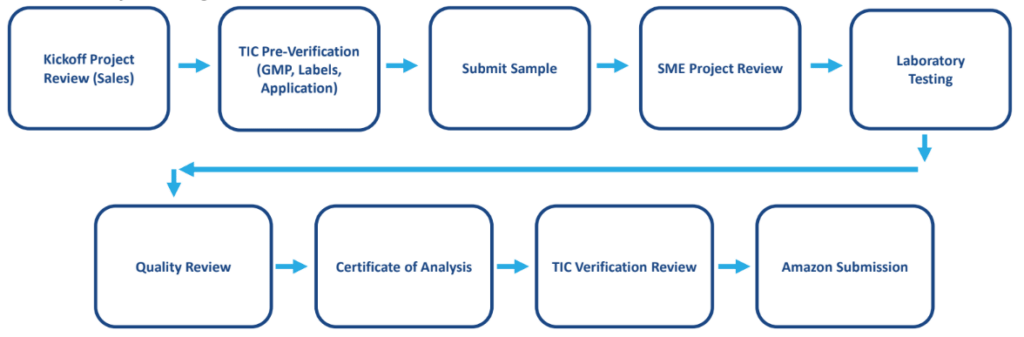
The laboratory process begins with a project kickoff. The seller and account team review the product, project scope, and required documentation.
Next, the TIC team conducts a pre-verification check. This step confirms that the GMP certificate is current, the correct label has been supplied, and the other required documents are available before testing begins.
After the sample arrives, subject-matter experts review the active ingredients, required analyses, product matrix, and appropriate analytical methods. The laboratory performs the testing, and the data pass through departmental and quality review before the COA is issued.
The COA then becomes part of the TIC verification review and final submission to Amazon. If verification is not approved, the team investigates the reason and works through a failure-resolution process to correct the problem.
What Testing May Be Required for Amazon Supplement Compliance?
The testing scope depends on the product, its claims, and its potential risks. Common analyses include:
- Label-claim and potency testing
- Heavy-metal testing
- Microbiological testing
- Pesticide and other contaminant testing
- Adulterant screening
- Identity testing
Amazon adulterant panels may apply to products marketed for weight loss, joint health, sexual wellness, sports performance, blood-glucose support, or sleep support. A product that falls into more than one category may need the applicable panels for each claim.
How Was Certified Laboratories’ Joint Health Adulterant Method Developed?
Certified Laboratories recently developed a method for Amazon’s joint health adulterant panel. Under applicable NSF 173-2024 criteria, the following compounds must not exceed 50 ppm in a product marketed for joint health:
- Acetaminophen
- Diclofenac
- Dexamethasone
- Indomethacin
- Ibuprofen
- Meloxicam
- Methocarbamol
- Prednisone
- Prednisolone
- Piroxicam
- Naproxen
- Hydrocortisone
The R&D team reviewed the target compounds and evaluated an appropriate procedure across gummies, capsules, tablets, and powders. The selected method used high-performance liquid chromatography with mass spectrometric detection and achieved a total analysis time of approximately 12 minutes for the analytes in the panel.
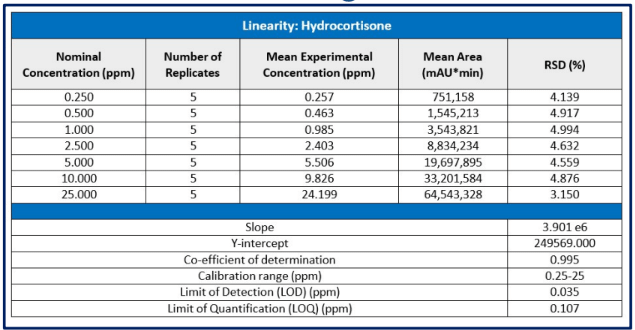
Linearity was evaluated from 0.25 ppm to 25 ppm. The method’s limit of quantitation for hydrocortisone was 0.107 ppm, well below the 50 ppm threshold, as shown below:
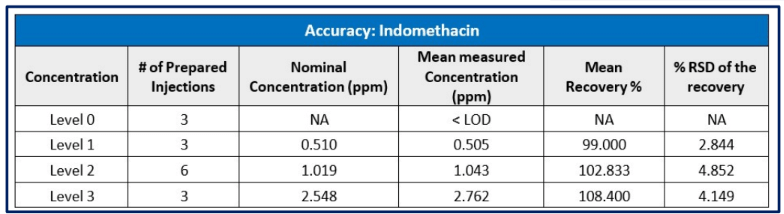
Accuracy was evaluated by spiking the sample with a certified reference standard and evaluating the percent recovery. The example below shows testing for indomethacin:
The completed HPLC-MS method was validated according to ICH guidance and met the predefined acceptance criteria in its validation protocol.
What Documents Does a TIC Provider Review?
Amazon supplement compliance is as much a documentation exercise as a testing exercise. The TIC provider may review:
- The certificate of analysis (COA).
- A current GMP certificate from an accepted certification program.
- The physical product label, including relevant artwork and text.
- The Amazon product-page description and online claims.
- Other product and verification documents requested for the case.
The online listing matters because it may contain claims or descriptions that do not appear on the physical label. Laboratory results, specifications, GMP records, physical labeling, and online product claims should all tell the same story.
What Problems Commonly Delay or Derail Verification?
Many compliance problems are preventable. Common examples include:
- A missing COA or a COA that does not meet the applicable requirements.
- Testing performed by a laboratory without the appropriate current accreditation.
- Missing TIC verification.
- Disease claims or other non-compliant labeling and marketing language.
- Undeclared ingredients.
- Expired or incomplete GMP documentation.
- Inconsistencies among the formulation, test results, label, and Amazon listing.
The goal is to identify and correct these issues before Amazon finds them during review.
How Can Certified Laboratories and EAS Consulting Group Support the Process?
Certified Laboratories operates ISO 17025-accredited laboratories that can support chemical and microbiological testing, including heavy metals, identity, potency, active ingredients, and adulterant panels. The laboratory issues the COA used in the verification process.
EAS Consulting Group can help manufacturers prepare for a Part 111 certification audit through a gap assessment or mock audit. That preparation can reduce the risk of major or critical findings that delay certification. If an audit identifies observations or nonconformances, EAS can also help develop corrective-action plans for review by the certification body.
Coordinating testing, TIC verification, and regulatory consulting through one network can reduce the burden of managing separate providers and help the seller resolve problems more efficiently.
What Additional Supplement Testing Is Available?
Amazon compliance testing is one part of Certified Laboratories’ broader capabilities.
Microbiology services include USP testing, microbial enumeration, specified-organism testing, yeast and mold, and pathogen analysis. Chemistry services include active ingredients, heavy metals, residual solvents, vitamins, and other contaminants.
Our laboratory network also supports accelerated, real-time, long-term, and refrigerated stability testing. When an established analytical method is not suitable for an ingredient or matrix, the R&D team may be able to develop and validate an appropriate method.
Amazon Supplement Compliance Q&A
Why Is TIC Verification a Separate Cost from Laboratory Certification?
The TIC verification fee covers the review of the seller’s GMP certificate, COA, product information, labels, and other supporting files. The TIC provider is not issuing the GMP certificate. It is performing a separate review to verify that the evidence satisfies the applicable Amazon requirements.
How Can Sellers Keep Up with Amazon Policy Changes?
Amazon can change its requirements without broad notice. Sellers should monitor Amazon Seller Central, maintain contact with their TIC provider, and review reliable industry updates and educational programs. When a requirement is unclear, ask Amazon or the TIC provider before submitting materials.
What Testing Is Needed for a High-Risk Product?
A high-risk product may require testing for contaminants such as heavy metals and microorganisms, the adulterant panel associated with the product category, and label-claim analyses. The final scope depends on the product, ingredients, claims, and Amazon case.
What Finished-Product Specifications Are Required?
The legal requirement is to establish specifications for identity, purity, strength, composition, and potential contaminants.
When the Supplement Facts panel gives a quantitative claim for a dietary ingredient, the manufacturer is generally expected to have a strength specification for that ingredient. If no scientifically valid analytical method is available, the manufacturer may document a justification, but FDA expects strong support, including relevant raw-material testing, in-process controls, and other available evidence.
A scientifically supported rotational testing program may also be appropriate in some situations.
Who Can Perform the GMP Certification Audit?
Amazon Seller Central lists organizations that can perform the required certification audits. If the manufacturer’s certification body does not appear on the list, the seller can ask Amazon whether the certification will be accepted.
Does a Certification Audit Replace an FDA Inspection?
No. FDA does not treat a third-party certification audit as a substitute for its own inspection. The FDA inspection relates to legal regulatory oversight, while the certification audit satisfies a separate Amazon marketplace requirement.
Is HPLC the Only Instrument that Certified Laboratories Uses for Amazon Testing?
No. The analytical technology depends on the target analyte and product matrix. Heavy metals may be analyzed by ICP-OES or ICP-MS. Pesticides may be tested by GC-MS, and residual solvents by GC-FID. Some Amazon panel compounds may be analyzed by HPLC-MS, while others may use HPLC with ultraviolet detection.
Does a Product with Sports-Performance and Joint-Health Claims Need Both Panels?
Yes. When a product is marketed for both sports performance and joint health, the testing plan should address the applicable compounds in both adulterant panels and confirm that results meet Amazon’s limits.
What Happens When a Test Result Is Out of Specification?
The laboratory follows its established out-of-specification procedure. The investigation determines whether the result may be related to an analytical error or represents a confirmed product failure. Amazon samples follow the same controlled OOS process as other routine testing.
What If No Suitable Analytical Method Exists?
The R&D team reviews the ingredient, analyte, product matrix, and available scientific literature. It then develops and validates a method that is fit for its intended purpose before the method is used for routine reporting.
How Can Rotational Testing Work for a Product with Many Ingredients?
A rotational program must be scientifically justified and supported by product history.
For example, after sufficient history has been established for a product with 15 ingredients, one lot might be tested for two fat-soluble vitamins, two water-soluble vitamins, and two minerals. A later lot would cover different ingredients in each group. This is only an example; the actual program must be designed for the specific product and process.
What Is Required for a Low-Risk Supplement?
Low-risk products still require applicable verification. Sellers need a current GMP certificate and COAs, but generally do not need the additional testing panels applied to high-risk categories. Sellers should confirm the current requirements for their specific product in Amazon Seller Central.
How Can a Laboratory Confirm Multiple Herbal Ingredients?
The method depends on the ingredients and matrix. HPLC-MS or GC-MS may be used to separate and identify compounds, with mass-spectral libraries and reference standards supporting identification. Other botanical identity methods may also be appropriate.
Are All Documents Uploaded to Amazon or Only the TIC Feedback Form?
The seller should work directly with the TIC provider on the full document package. The provider reviews the applicable files and manages the verification information submitted through Amazon’s process.
Why Must the TIC Process Begin in Amazon Seller Central?
The seller must initiate the case under the appropriate product in Amazon Seller Central and select the TIC provider there. Emailing a laboratory or provider outside the Amazon workflow does not create or connect the required verification case.
Can Certified Laboratories Test Botanical Products?
Yes. Available approaches include high-performance thin-layer chromatography and liquid chromatography. Certified Laboratories also maintains a broad library of botanical reference standards. The method is selected according to the botanical ingredient, product matrix, and purpose of the test.
Does FDA Issue a Certificate After an Inspection?
No. FDA may issue Form FDA 483 listing inspectional observations. The agency may also issue an Establishment Inspection Report, but that report is not a GMP certificate.
Must Every Batch Be Tested?
Manufacturers must ensure that every batch meets established specifications. Depending on the product, methods, history, and scientific justification, a compliant rotational testing program may be used to support that determination.
Start the Amazon Compliance Process Early
Requirements can change, testing and verification take time, and documentation problems may delay approval. Begin before an annual deadline or listing issue becomes urgent.
Certified Laboratories and EAS Consulting Group can help determine the testing, documentation, and regulatory support appropriate for a product and guide sellers through the next steps. Contact us with your Amazon supplement compliance needs.
